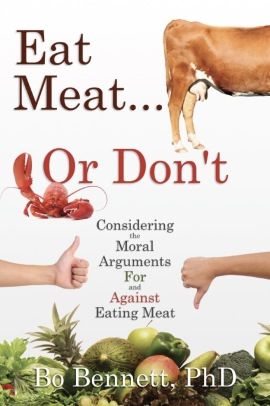
As you start to list properties that the animal lacks to justify eating them, you begin to realize that some humans also lack those properties, yet we don’t eat those humans. Is this logical proof that killing and eating animals for food is immoral? Don’t put away your steak knife just yet.
In Eat Meat… Or Don’t, we examine the moral arguments for and against eating meat with both philosophical and scientific rigor. This book is not about pushing some ideological agenda; it’s ultimately a book about critical thinking. But moral facts shouldn’t be confused with ideology. When it comes to moral choices, there are better ones and there are worse ones. If you act rationally and ethically and have adopted a good moral framework, you might come to the justified conclusion that eating meat is unethical… or you might not. Regardless of your conclusion, you will almost certainly realize that eating less meat is a fantastic idea for your health, the environment, and especially animals, and it’s an easily achievable goal that will change your life for the better.
ISBN (ebook): 978-1-4566-3334-9 / ISBN (print): 978-1-4566-3333-2 / Published by: Archieboy Holdings, LLC. / Published: 2019-07-01
I wrote about the "Name the Trait" argument in a section of my book that was created by YouTuber "Ask Yourself". He managed to get his hands on an unedited, pre-release version of my book and created a response video at https://www.youtube.com/watch?v=Tl-Cxh1SZkc. This is my response to that response.
The video begins with a textbook example of poisoning the well, which is essentially a technique where one manipulates the audience to have negative and antagonist feelings toward the opponent before any arguments are made. Ask Yourself tells his audience the following:
Then, right after saying all that, he asks me to do a public debate with him. His formal invite is “Bo, don’t be a weasel little coward,” which is a little different than how universities invite me to give to lectures. He assumes that if I don't want to debate him, it is because I "cannot defend [my] ridiculous position." The fact is, I already attempted to have a civil conversation with him that resulted in repeated insults on his part. Let's just say that I am not interested in attempting another conversation with him. But I am happy to respond to his criticism here. (I have had several recorded conversations with both vegans and meat-eaters where my positions were challenged; you can find those in the "Media" section.)
It is also clear that Ask Yourself has not read my book. So many of his criticisms and confusion has to do with the fact that he clearly only read the "Name the Trait" section. Therefore, I am only going to focus on the criticisms that are not a result of this problem.
In the trait equalization section, I pose some questions such as "[Does] an articulate pig with a human intellect [have moral value]?" and ask if these questions are even valid. I pose the question in this section, then answer it in the following sections. No, asking anything about "pig" with "human" intellect is not valid because not only physically, but logically, a being cannot be both a pig and a human as it is a violation the law of contradiction. I explain this in the later section where I show how a "human" mind is only human because it belongs to a human. If one were to claim that a "human" mind can logically exist in a pig, they would need to explain how, in any sense of the word, the mind would still be "human." This is just like trying to explain that a non-round circle could logically still be considered a circle.
I am then accused of "being an obnoxious pedant” by explaining this problem of identity. The obnoxious part aside, the "pedant" implies that I am harping on a non-trivial point. The fact is, this is a crucial point of the "Name the Trait" line of reasoning that I cover in great detail in the "supplemental arguments" section. People who use these arguments rely on emotional manipulation by using the "human" label even when that label is not justified. Ask Yourself claims that the use of "human" is just for simplicity, and perhaps that is his intent, but this is simply unjustified. Hybrid organisms are not the same as humans.
This section serves an important point already mentioned above. Ask Yourself claimed that this section was “Bo taking cheap shots at the a straw man of the actual argument.” First, this wasn't even a representation of the argument so it can't be a strawman of the argument; it was the result of countless instances on the internet where people using the "Name the Trait" argument as well as Ask Yourself himself, attempts to cling on to the "human" label for manipulation purposes rather than concede that the being in question is an impossible hybrid creature. Taking away moral value from a "human" is far more unpalatable than taking away moral value from some 1/2 pig 1/2 human creature. Even if nobody has ever conflated the label "human" with an organism that is not-human, this wouldn't matter. This section is instructional in that it should be clear to all parties what constitutes a human.
Ask Yourself takes issue with the following:
He doesn't see the difference in the two and ridicules me for my ignorance rather than entertaining the possibility that he might just not understand. I do appreciate feedback like this because I do think Ask Yourself knows more about logic than the average reader, and if my point is not clear to him, it is likely not clear to others. So let's look at these questions:
He seems to recognize that this is a fallacy known as begging the question, because the question assumes the a human can lose moral value and still be human. Once the human loses the moral value, it is implied that there is no change to the humanity of the human. What we are left with is a human without moral value. So far so good. I then give an example of a similar question that avoids this problem.
Here, if one loses "humanity" then by definition, they are no longer human. We are not begging the question that we can have a human without humanity. Words matter, and people can easily be deceived by calculated wording that have implications. The point is, be aware of the question begging fallacy. The question "At what point does the human lose its full moral value?" assumes a human can lose moral value and implies that humanity remains, or at the very least, makes no claim that humanity is lost whereas my second example makes it very clear that humanity is lost.
Update: Wednesday, Aug 21, 2019 09:47 AM
Updated book to read:
Ask yourself objects to my claim that the argument implies "if humans have moral value then so must animals." This wasn't me claiming what the conclusion states (I already listed the exact argument and it's formal conclusion); it is my interpretation of what the conclusion implies. This is not relevant beyond my attempt to simplify this for the average, non-logician reader who has no idea what the argument means. This was based on feedback I received from several editors - none of them could make sense of the "Name the Trait" argument. I stand by this implication. I encourage you to read through the argument several times and challenge this implication. Again, it is not substantive in any of my criticisms; it is simply a user-friendly summary of what the conclusion implies.
I wrote:
with the footnote "The 'as it pertains to moral evaluation' was added by me for clarity." I apologize if my attempt at clarity was unsuccessful. There is no reason to consider any trait not related to moral evaluation, and such traits would only make the argument unnecessarily complex. We don't care if humans can knit or juggle--unless this is morally relevant. I don't see how in any way my addition hurts the argument, in fact, it strengthens it.
I get that if one's view does NOT affirm a given human is trait-equalizable to a given nonhuman animal while retaining moral value, then this argument does not apply to them. I think my use of the word "defeated" struck an emotional note with Ask Yourself. Remember that this books is not written for logicians. This might be "basic" for logicians who are used to formal argumentation, but not the vast majority of people who are asked to respond to this argument on the fly.
I presented the following argument to demonstrate that valid arguments don't have to apply to you, the same point Ask Yourself makes in his "dialog tree." I am not sure why Ask Yourself took this as an attack on the argument; again, it was just basic information demonstrating how arguments don't have to apply to everyone.
Ask Yourself claimed that I was wrong in claiming how to make my example argument valid. I should point out that again, this has nothing to do with the criticism of the name the trait argument in that even if Ask Yourself was right, it would not affect this criticism towards his argument.
1. If in some imaginary world, plants had the same level of sentience as humans, it would be immoral to eat them.
2. In some imaginary world, plants do have the same level of sentience as humans.
3. Therefore, it is immoral to eat plants.
I wrote:
Ask Yourself claimed that I was wrong and we also need to change the consequent in the first premise. So let's look at what I consider to be the valid argument:
1. If in some imaginary world, plants had the same level of sentience as humans (P), it would be immoral to eat them (Q).
2. In some imaginary world, plants do have the same level of sentience as humans (P).
3. Therefore, it is immoral to eat plants in this imaginary world (Q).
This is a perfectly valid argument without changing the consequent as Ask Yourself claims. If P then Q. P. Therefore, Q.
I wrote:
Ask Yourself says "He [Bo] claims that the dualist believes the mind can exist without the brain" then Ask Yourself claims this is "false." It is only false if I wrote "every dualist." As expected, Ask Yourself is not attempting to offer a charitable interpretation. I will accept responsibility for not being precise in my language. I have updated this in my book to read:
If one is a dualist, they likely believe that the mind can exist independent of the physical brain (biological or artificial, as in some advanced AI).
Ask any religious person you know if God has a physical brain and they will tell you "no." Ask them if "people in heaven" have physical brains and they will tell you "no." Ask ghost believers if ghosts have physical brains and they will tell you "no." Ask Yourself is confusing "can" with "must." If I were to claim that the dualist "believes that the mind MUST exist independent of the physical brain" then I would have been wrong, but I didn't, so I'm not. Ask Yourself then goes on to say "A dualist must believe that the mind and brain are separate substances. It could still be that one depend on the other.” This doesn't matter if it is true or not. What does matter in this section on "mind games" is that unless one brings magic into the equation, the mind cannot be separated from the brain.
I wrote:
Ask Yourself objected to my use of a logical impossibility (the non-round circle) to compare it to what he calls my physical impossibility example (a human mind in a pig). I maintain that this is a logical impossibility because it is logically impossible to have a "human" mind in a non-human being, because the mind is a product of the biology, the non-human biology would make the mind "non-human." Because something cannot be both human and non-human at the same time, this violates the (logical) law of contradiction.
Ask Yourself made a handful of claims , only a few of which related directly to "Name the Trait" argument. I have responded to all of them demonstrating that my initial analysis was correct. As a result of his criticism, I did make some clarifications in order to facilitate understanding, but I made no substantial changes in this section.
I hold no ill will against "Ask Yourself" or any person who takes the time to offer feedback to my work, no matter how "undiplomatic." I believe how people give "feedback" says far more about the person giving the feedback then any personal claims made against the recipient in the "feedback." We can't control how others treat us, but we can control how we treat others.
A special note to all the subscribers to "Ask Yourself":
What Ask Yourself didn't tell you is that my book strongly supports eating less meat. My book is full of excellent arguments, far better than "Name the Trait" in favor of not eating meat (I don't go into veganism vs. vegetarianism). I can't stress enough that by adhering to a belligerent "gotcha" type of vegan argument similar to a Christian presuppositionalist you are doing more harm to the cause than good. Beyond the arguments, I go in the psychology of changing behavior and persuasion techniques that will help people see your point of view. Read the book, the whole book, for FREE, on me. I will make the ebook and/or audiobook available for free to you until at least September 1, 2019. Just send me a message using the contact form on this website (https://www.sentiocentrism.com) requesting either the ebook or audiobook, and let me know that you are a susbscriber of "Ask Yourself."
As for all the horrible things said about me personally, I ask that you check out my work on LogicallyFallacious.com and the many books I have written on reason and critical thinking, and my YouTube channel. I have spent over a decade promoting reason and critical thinking and integrating these important topics in my lectures as a college professor. If, after reviewing a decent sample of my work you still think that I am a dishonest weasel, little coward, massive sophist, who writes cringy, holocaust apologia, then at least you came to that conclusion on your own ;)